Deep learning is beginning to attract great attention from many businesses. It drives smart gadgets, recognizing faces, voice assistants, and other technologies. Companies believe it will help businesses to grow quickly and function more efficiently. However, it's not the perfect solution for every business. It requires significant time, financial investment, and big amounts of data.
Deep learning also requires certain knowledge to be applied properly. The complexity can surpass the benefits for small and medium-sized businesses. Many times, more fundamental remedies could solve problems. This guide looks at when deep learning is worth considering and when it could be unnecessary. Knowing the costs, data needs, and obstacles enables businesses to choose better for their IT needs.

Before deciding on deep learning for your company, consider important factors like data demands, expenses, and complexity.
Deep learning is great when it can utilize lots of data. Analyzing large datasets helps it learn patterns and enable accurate predictions. However, numerous small—and medium-sized companies lack sufficient data. Moreover, compiling reliable data takes time and money. Cleaning untidy or lacking data might take time and slow advancement. Unlike deep learning, conventional machine learning systems may operate effectively with minimal datasets. Deep learning is not the best answer for companies without much data. In such situations, simpler methods might prove more successful.
The needed resources for creating deep learning systems make them costly. Training models depend on specialized technology, such as GPUs, which might be expensive but vital. Besides, data storage and cloud services add to the cost. Another major expense is recruiting qualified data scientists since these experts are highly desirable and demand good pay. Long-term expenses also result from regular updates and system maintenance. Establishing and sustaining deep learning systems can be too costly for small companies. More often than not, simpler tools provide a quicker, less expensive substitute with the same outcomes.
Deep learning models frequently qualify as “black boxes.” They provide outputs and process data, but their decision-making approach is opaque. This opacity is troublesome, particularly in sectors like finance or healthcare, where knowledge of decision rationale is crucial. Lack of clarity makes it harder to trust or justify the choices of the model so that possible mistakes could result. Often a major need for companies, traditional models such as decision trees provide a clear understanding of how decisions are made. If integrity and accountability are valued, deep learning may not be the ideal choice for your company.
Teaching deep learning models takes time. It starts with data collection and cleansing and then develops intricate models. Evaluating and improving every round of the model can take hours or even days. Businesses looking for immediate results could find this long schedule troublesome. In fast-paced marketplaces, quick response is essential; hence, waiting for deep learning models to provide can impede development. Faster training and deployment of simpler machine learning models give companies immediate solutions without waiting for long development times.

Not every corporate problem calls for deep learning as a solution. Many corporate chores can be handled using simpler, less complicated approaches. While deep learning shines at tasks like picture identification or audio analysis, other corporate needs, such as forecasting or customer segmentation, do not necessitate such sophisticated solutions. Many jobs can be completed with simple technologies such as spreadsheets, rule-based systems, or simple algorithms. If a basic fix produces good results, there is no need to complicate matters with deep learning. A simpler strategy can save time, cut expenses, and produce better results.
Keeping a deep learning system functioning properly is never easy. It calls for constant updating, model tuning, and troubleshooting. Your system must change as your company grows, requiring time and effort. Moreover, the challenge is scaling deep learning systems. If your company expands or the data volume rises, the system can call for extra storage capacity and computational capability. This scaling problem can cause more expenses. These pressures can become intolerable for a developing company. Managing an easier, less resource-intensive system could be easier than one that guarantees seamless operations free from ongoing maintenance or scalability difficulties.
Deep learning calls for particular programming, mathematics, and data science knowledge. Difficult to find and highly paid for, skilled experts in various disciplines are in Project failure can follow from trying to create a deep-learning technique without this knowledge. Developing your current staff could require a lot of effort and money. Moreover, choosing the wrong personnel could result in wasted money or ineffective performance. Many companies find applying machine learning techniques without advanced technical expertise more sensible than those requiring thorough technical knowledge. Teams without knowledge of deep learning will find these platforms more easily available since they offer already-built models with lower management and integration requirements.
Deep learning initiatives frequently have unknown results. The approach does not guarantee a notable commercial benefit or predicted performance. Deep learning initiatives are dangerous because of their volatility, particularly for tiny companies with limited means. The return on investment could not justify the time, effort, and money spent on the project. Before pledging to deep learning, companies must thoroughly assess the possible advantages. Many times, simpler technologies or approaches may offer a greater ROI with less risk, delivering value more effectively without the risks and significant expenses linked with deep learning.
One potent yet sophisticated instrument is deep learning. It calls for big datasets, big financial outlay, and specific knowledge. Establishing and preserving these systems calls for time and money. Several small and mid-sized companies find that the difficulties exceed the benefits. Often, simpler solutions are faster, less expensive, and easier to apply. See whether simpler approaches meet your needs before delving into deep learning. Think through your long-term objectives, team capacity, and financial situation. Selecting the appropriate instrument depending on your business needs guarantees a more efficient, affordable approach consistent with your firm's objectives.

AI in space exploration is changing how we study distant planets. Discover how autonomous rovers and mission planning powered by AI are shaping the future of space missions

How Convolutional Neural Networks are transforming image processing across industries, enabling machines to interpret visuals with precision and speed

AI for Smart Cities is transforming urban living by improving traffic and energy management systems. Discover how smart technologies are making cities more efficient and sustainable

Find out the key differences between symbolic AI vs. subsymbolic AI, their real-world roles, and how both approaches shape the future of artificial intelligence

AI in Art is reshaping creative industries with Generative Art and Music. Learn how artists are using AI creativity tools to explore new artistic possibilities and redefine modern expression

Learn five powerful ways machine learning transforms digital marketing through smarter targeting, personalization, and support

Neuromorphic computing is transforming artificial intelligence by mimicking the human brain. Learn how AI inspired by the human brain is leading to smarter and more energy-efficient technology

Meet the top AI influencers of 2025 that you can follow on social media to stay informed about cutting-edge AI advancements

best YouTube channels, StatQuest with Josh Starmer, channels focused on applied statistics
Discover 7 free and paid LLMs to enhance productivity, automate tasks, and simplify your daily personal or work life.

From predicting customer preferences to improving supply chain management, AI has transformed the retail industry in various ways
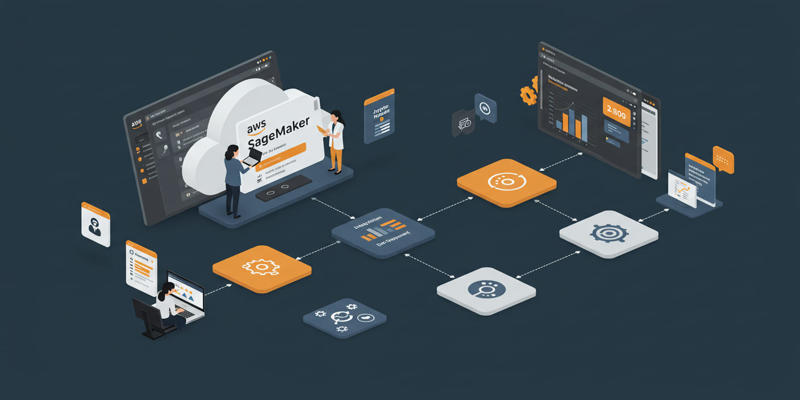
SageMaker Unified Studio AWS creates one unified environment connecting analytics and AI development processes for easy data management, data governance, and generative AI workflow operations.